Every company has an invisible layer of work.
It is not always visible to clients, students, partners, or even to people outside the team. But it is there every day — in messages, spreadsheets, calendars, meetings, reminders, manual follow-ups, repeated decisions, and small operational details that quietly decide whether the company runs smoothly or not.
At Business Development Group, we manage a large number of educational programs, courses, events, and internal processes at the same time. From the outside, a course may look simple: a topic, a trainer, a schedule, a group of students, and a certificate at the end.
But inside the company, every course is a full operation.
There are people preparing the launch, people working on communication, people managing student registration, people coordinating trainers, people checking schedules, people handling rooms, people following up with students, people creating certificates, and people making sure that every part of the process actually happens on time.
For a long time, many of these workflows were spread across different tools.
Some things lived in Google Sheets.
Some things lived in Slack.
Some things lived in documents.
Some things lived in people's memory.
It worked — but only because the team made it work.
At some point, I realized that the real problem was not simply that we needed "another tool".
The real problem was that our operations had outgrown the tools around them.
That was the starting point for BDGuru.
The First Question
When I started building BDGuru, I was not trying to create a big platform.
The first question was much simpler:
What if opening and managing a course could happen from one place?
Not in a spreadsheet.
Not in a chain of messages.
Not in five separate documents.
One place.
A course should not be just a row in a sheet. It should be a living workspace where the team can see what is happening, what is missing, what needs attention, and what comes next.
That idea became the foundation of BDGuru.
Why Internal Tools Matter
Internal tools are often underestimated.
People usually pay more attention to products that customers see: websites, landing pages, mobile apps, public platforms. But in many companies, the biggest bottlenecks are not on the surface. They are inside the company.
They are hidden in small questions:
- Who is responsible for this?
- Did we already prepare this material?
- Is the schedule updated?
- Did someone confirm the student?
- Which room is available?
- What happens this week?
- What still needs attention?
- Where is the latest version?
When these questions are answered manually every day, the team loses time and energy.
A good internal product does not just store information. It reduces uncertainty.
That is what I wanted BDGuru to do.
Turning a Workflow Into a Product
The first version of BDGuru focused on course launches.
When a new course is created, many teams need to act around it. The project manager needs to add the key information. Marketing needs to prepare communication. Sales needs to support the registration flow. Support needs to coordinate the operational side.
Instead of keeping all of this scattered, BDGuru brings the course into the center.
Every course becomes a structured workspace.
From there, the system can understand the course lifecycle, its schedule, its team responsibilities, and the operational signals around it.
This was an important product decision:
BDGuru is not built around tasks. It is built around the course as the main operational object.
That made the product much more natural for the team.
The Calendar Became More Than a Calendar
One of the biggest parts of the system is scheduling.
At first, a calendar may sound simple. You show dates, times, and lessons. But in a real education company, the calendar is much more than a calendar.
It is capacity planning.
It is room management.
It is weekly operations.
It is team coordination.
It is a source of payment and support signals.
It is a way to understand what the company can realistically run.
BDGuru's calendar evolved step by step.
It started with showing courses and lessons. Then it became more operational: weekly views, room visibility, support duty planning, non-working days, and important lesson milestones.
Some of these details may look small from the outside, but inside the company they make a big difference. They help the team understand not only what is scheduled, but what needs attention.
That is where the product starts becoming useful every day.
From Manual Reports to Operational Signals
One of my favorite parts of BDGuru is how it replaces repetitive manual reporting.
Before, some weekly operational updates had to be prepared manually. The team would collect information, format it, post it in Slack, and make sure everyone had the right context.
Now, parts of this workflow can be generated directly from the system.
The weekly schedule is no longer just something someone writes manually. It comes from structured operational data.
This is the kind of automation I like most: not automation for the sake of automation, but automation that removes repetitive work while keeping the team aligned.
And this is only the beginning.
Students Became the Center
As BDGuru grew, one thing became clear: the most important part of every course is not the checklist, the schedule, or the dashboard.
It is the students.
For a long time, student operations were handled through spreadsheets. That made sense in the beginning, but spreadsheets eventually become difficult to scale. They are flexible, but they do not understand workflow.
So instead of simply copying a spreadsheet into BDGuru, we redesigned the logic.
Students are now becoming a core part of the course workspace.
Not as rows in a table, but as operational entities with status, history, notes, and context.
This is a very important shift.
A spreadsheet shows information.
A product guides the workflow.
That difference matters.
Certificates, Verification, and Trust
Another part of BDGuru is certification.
Certificates are important because they represent completion, achievement, and trust. But if certificates are created manually, the process can become slow and difficult to verify.
So we started building a more modern certificate flow.
The idea is simple: every certificate should be connected to a verification layer.
Instead of relying only on a static design, the certificate can be verified through the system. This opens the door to QR-based verification, public validation pages, and a more trustworthy credential experience.
I believe this is a much stronger direction for education companies.
Certificates should not only look official.
They should be verifiable.
Building Around Real Operations
One thing I learned while building BDGuru is that internal products should not be designed from abstract assumptions.
They should be designed from real behavior.
Every feature in BDGuru started from a real friction point:
- too much information in different places
- repeated manual work
- unclear ownership
- schedule changes
- missing confirmations
- room conflicts
- student tracking
- certificate generation
- weekly operational reporting
The product became stronger because it was built close to the team's real workflow.
That is also why I avoided making BDGuru a generic management platform. It is not trying to be everything for everyone.
It is designed around the way BDG actually works.
Why I Did Not Start With AI
BDGuru has a lot of future potential for AI.
AI can help generate content, suggest schedules, detect risks, summarize operations, create scripts, prepare reminders, and support decision-making.
But I did not want to start with AI as the main feature.
Why?
Because AI is only powerful when the underlying system is structured.
If the data is messy, AI becomes a layer on top of confusion.
So the first goal was to build the operational foundation: courses, schedules, students, roles, certificates, calendar logic, and team workflows.
Once the structure is strong, AI becomes much more meaningful.
For me, this is the right order:
First, structure the operation.
Then, automate intelligently.
Then, add AI where it creates real leverage.
What BDGuru Is Becoming
BDGuru started as a simple internal tool.
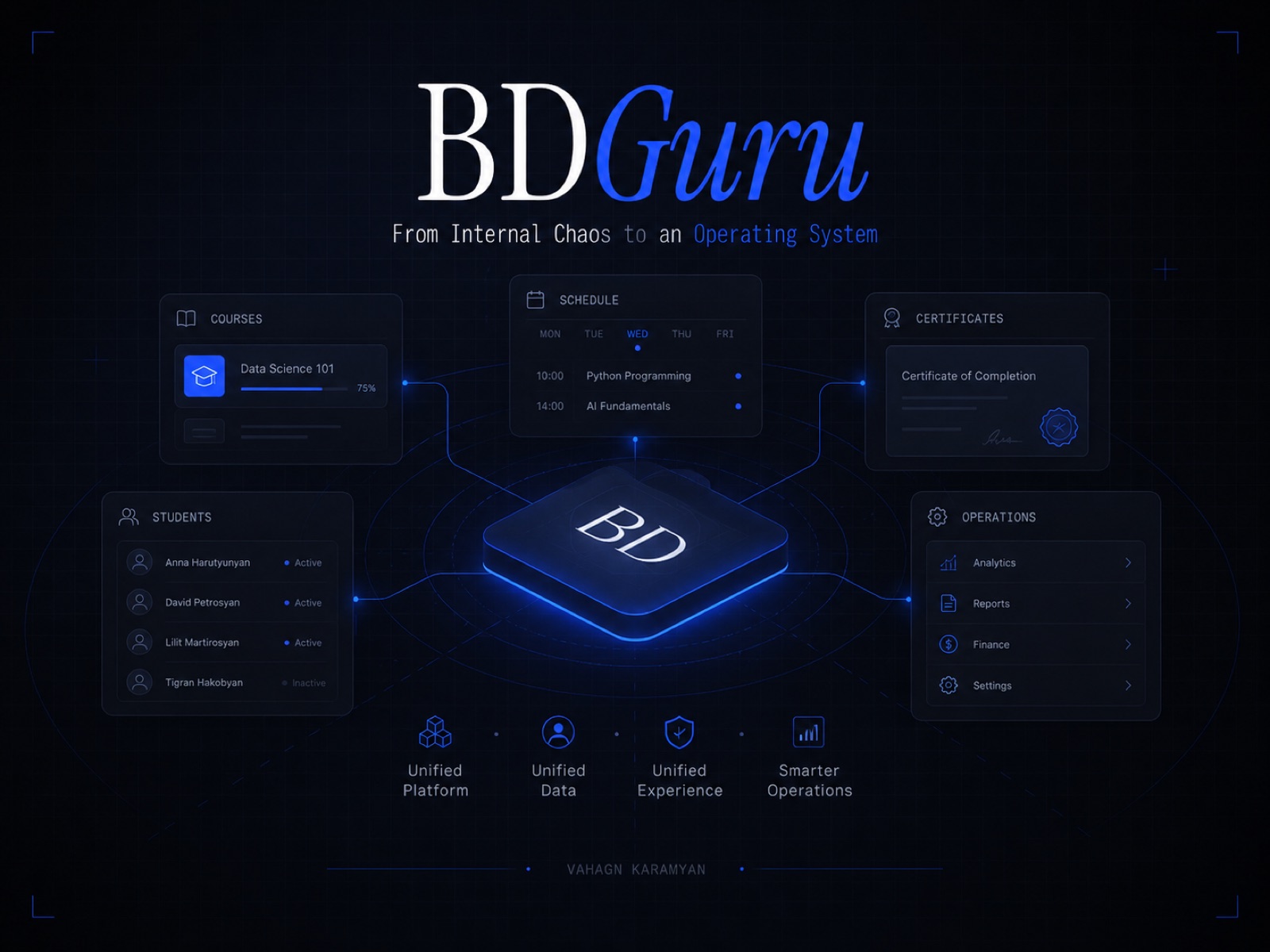
Today, it is becoming something much bigger: an operating system for how we manage educational programs inside Business Development Group.
It connects different parts of the company into one shared workspace.
It helps the team see what is happening.
It reduces repetitive work.
It makes operations more structured.
It creates visibility.
It prepares the foundation for future automation.
And maybe most importantly, it turns internal complexity into a product.
That is what makes this project exciting for me.
The Bigger Idea
I believe many companies have a version of this problem.
They grow.
Their operations become more complex.
Their teams start relying on spreadsheets, messages, and manual coordination.
At first, it works.
Then it becomes fragile.
BDGuru is my answer to that problem inside BDG.
It is not just about building software. It is about understanding how a company really works and turning that understanding into a product.
Some parts of the system are still internal. Some parts are still evolving. And some of the most interesting layers are not public yet.
But the direction is clear.
BDGuru is becoming the infrastructure behind our education operations.
And for me, this is one of the most interesting types of products to build:
a product that is born from real problems, shaped by real users, and improved through real daily work.
Building BDGuru also taught me a smaller, personal version of the same lesson years earlier, when I automated my own information-gathering workflow as a designer — a much lower-stakes precursor to this project, written up in From Manual Browsing to Intelligent Automation.